Skip links

Technical information

LIQUID-COOLED PLATES

Material and mechanical processing 

Lightness (2.7 g/cm³), thermal conductivity (120–229 W/m•K) and high workability are the properties that make aluminium the main material used to manufacture our LCPs. Depending on the technology used to manufacture the liquid-cooled plate, different types of material can be used for the base plate.  

In addition to the more common extruded solution, the raw material can also be supplied in cast plates, which offer maximum dimensional flexibility and no additional costs for the manufacture of dedicated dies.  

Unless otherwise specified in the design, the products are machined in accordance with the general tolerances specified by ISO 2768-mK, maximum surface flatness 0.05/100 mm and maximum roughness Ra 1.6 µm. However, unless otherwise specified, parts that do not comply with the prescribed general tolerances should not be automatically rejected when the functionality of the part is not compromised.  

How to choose a liquid-cooled plate

Liquid cooling is the most effective way to dissipate the heat generated by electronic components, offering performance that cannot be achieved with air cooling while limiting the overall dimensions. As with an air cooler, the thermal performance of an LCP is measured by the thermal resistance RTH [K/W], which describes how much hotter the surface (TMAX) becomes in relation to the inlet temperature of the coolant (TIN) flowing inside, for a given thermal load represented by the power to be dissipated generated by the electronic devices to be cooled (Pd). The maximum thermal resistance value of an application is determined by the formula:

It is therefore necessary to design and identify the LCP with a thermal resistance equal to or lower than that calculated.

The thermal performance of an LCP depends on the flow of the coolant passing through it. To increase its performance, Mecc.Al offers the option of installing special accessories – turbulators or offset fins layers – capable of increasing fluid turbulence for greater heat dissipation efficiency.
When selecting the technology for manufacturing an LCP, particular attention must be paid to the type and quality of the coolant used to prevent corrosion. As the aggressiveness of the coolant increases, it is necessary to switch from aluminium channels to copper or stainless steel ones.
Equally important for the sizing of a liquid-cooled plate is the definition of the maximum permissible pressure drop, identified by the cooling system of the liquid leaving the LCP. As the flow rate through the LCP increases, the thermal resistance decreases, while the pressure drop increases.

Thermal resistance and pressure drop measurement conditions

The products are presented in order of size, expressed in millimetres, with corresponding graphs showing thermal resistance and pressure drop as the coolant flow varies. The graphs refer to some of the countless possible configurations of the various manufacturing technologies.  
Each LCP project is developed and manufactured according to precise design specifications, ensuring an optimised product right from the prototyping stage. Mecc.Al’s Technical Department uses a modern CFD calculation system which, for the different configurations of the cooling channels, allows the reliability of the design specifications in terms of thermal resistance and pressure drop to be verified.

The technical data reported is derived from software simulations and laboratory tests, according to the assembly layout shown in the drawing and considering the maximum point temperature reached on the surface of the LCP. The coolant used is pure water at an inlet temperature of 40 °C and a pressure of 202,650 Pa.

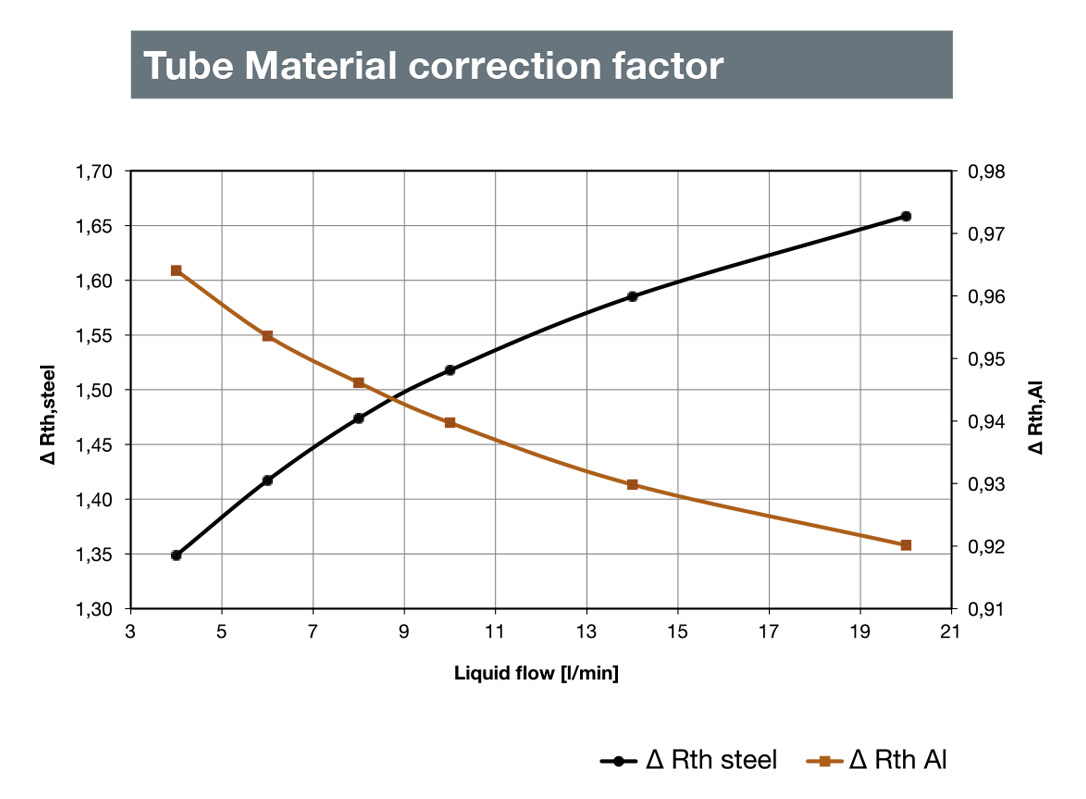
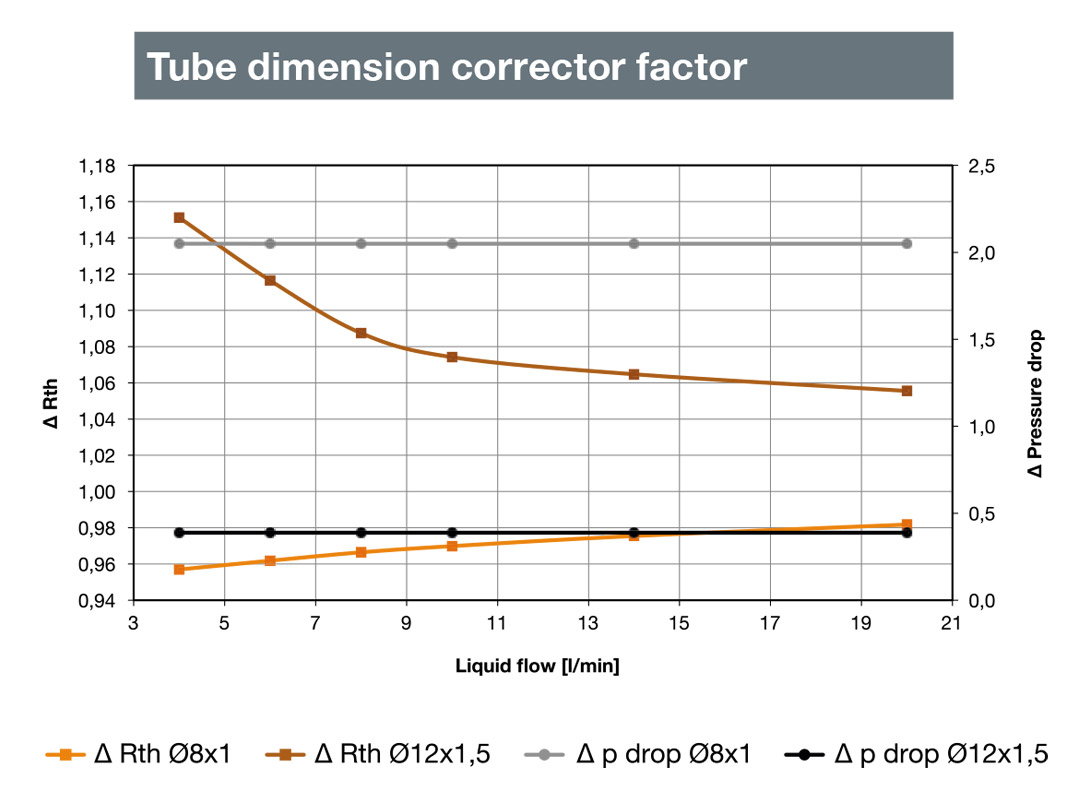
In assembled tube technology, the coils are made of copper, with a diameter of 10 mm and a wall thickness of 1.5 mm. For different tube materials and sizes, please refer to the ‘Tube Material correction factor’ and ‘Tube Dimension correction factor’ graphs to determine the multiplication factor to be applied to the indicated thermal resistance and pressure drop values.  
The design flexibility of Mecc.Al liquid technologies offers various possibilities for the positioning of the coolant inlet and outlet terminals, as well as a wide range of fittings types that can be assembled.  

Standard fittings:  

  • soldered or brazed brass fittings with male/female GAS thread or hose adapter
  • stainless steel/brass push-on fittings with ogive

Custom connectors:  

  • turned copper/brass soldered or brazed fittings
  • copper or steel connector blocks soldered or brazed to the ends of the pipe and mechanically assembled to the base plate
  • aluminium fittings or blocks brazed or mechanically assembled 

Surface treatments:  
Anodising, passivation and nickel plating, applicable depending on the construction technology used, have a negligible effect on thermal performance but are mainly used to improve surface corrosion resistance.  

Every single LCP produced by Mecc.Al undergoes leakage testing and tracking.  

The technical data reported, derived from laboratory tests and thermal simulations, are to be considered reliable. However, since actual conditions of use may differ from those in the laboratory, it is advisable to verify them through empirical testing under the actual conditions of use of the LCP.  

Ricerca avanzata

Trova subito il prodotto ideale
[wpdreams_ajaxsearchpro id=1]
Dissipatori raffreddati
AD ARIA
Piatti raffreddati
A LIQUIDO
Piastre e placche
ALplate